Karait
The Jungle BookKarait is a dusty brown snakeling whose brief appearance turns an apparently safe moment near the house into a sudden contest between concealed danger and alert protection. Though he is minor in the larger story, his attack on Rikki-tikki-tavi provides the mongoose's first decisive victory over a snake and demonstrates that lethal threat is not measured by size.
Identity and Threat
Karait lies by preference on dusty ground, where his smallness makes him easy for people to overlook. The narrator stresses that his bite is as dangerous as a cobra's, and that his inconspicuous form enables him to do greater harm because people do not think of him. His warning to Teddy, "Be careful. I am Death!", gives the little snake a voice of menace while also revealing the danger that the household has failed to notice.
Karait is therefore defined by a sharp contrast between appearance and consequence. He is tiny, dusty, and easily dismissed, yet his venom makes a casual encounter potentially fatal. His danger differs from that of Nag and Nagaina not because it is weaker, but because it is compressed into a smaller body and hidden in an ordinary patch of earth.
Encounter with Rikki-tikki-tavi
Karait appears just as Teddy bends toward Rikki-tikki-tavi. The mongoose has already escaped a strike from Nag and Nagaina, but he does not yet feel certain that he could manage both cobras at once. Karait's emergence changes the situation immediately: the threat is now close to the child, and Rikki-tikki-tavi must respond without the advantage of preparation.
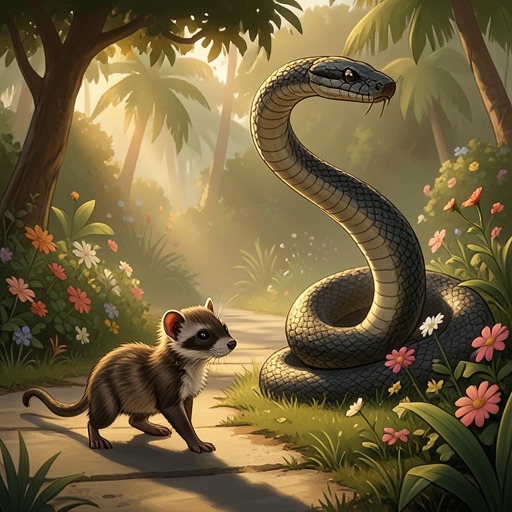
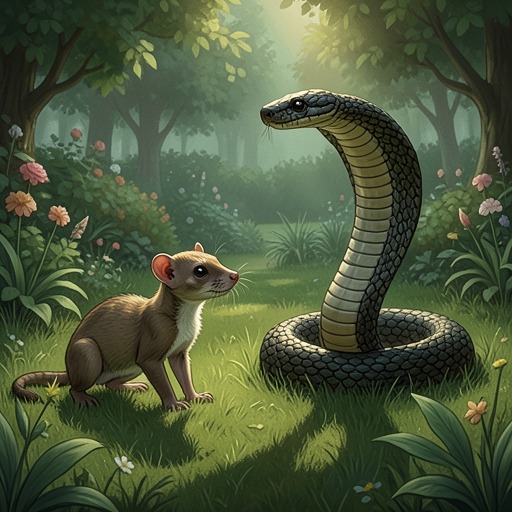
Rikki-tikki-tavi's eyes turn red with anger, and he advances with the rocking, swaying gait inherited from his family. That movement is not mere comic display. It keeps him balanced and ready to spring in any direction, a physical adaptation particularly useful against snakes. Karait is especially dangerous because his small body can turn quickly; unless Rikki-tikki-tavi bites close to the back of the head, the snake can deliver a return strike toward the mongoose's eye or lip.
The attack becomes a rapid exchange of failed openings. Karait strikes, Rikki-tikki-tavi jumps sideways and tries to close in, and the snake's head follows him so closely that the mongoose must leap over the body. The scene makes survival depend on timing rather than strength: the snake's blow and the mongoose's jump are separated by only a fraction of a moment.
Death and Immediate Consequences
Karait finally lunges too far. Rikki-tikki-tavi springs onto his back, drops his head between his forelegs, bites as high on the back as he can reach, and rolls away. The bite paralyzes Karait. Rikki-tikki-tavi is about to eat the snake from the tail, following his family's customary manner of feeding, but restrains himself because a full meal would make him slow when he needs his strength and quickness.
Teddy's father beats the dead Karait with a stick, although Rikki-tikki-tavi regards the action as unnecessary because he has already settled the matter. Teddy's mother picks up the mongoose, hugs him, and says that he has saved Teddy from death; Teddy's father calls him a providence. Rikki-tikki-tavi does not understand the household's excitement and treats the attention as an amusing fuss, but the family has correctly recognized the consequence of Karait's attack: the small snake's death has preserved Teddy's life.
Narrative Function and Significance
Karait's encounter establishes the practical terms of the story's animal conflict. Rikki-tikki-tavi does not defeat snakes through a magical herb, as old natural-history books supposedly claim; the narrative explains that victory depends on quickness of eye and foot. Karait's attack makes that principle visible, turning natural agility into a form of protection for the human household.
The episode also gives Rikki-tikki-tavi confidence. He knows that he is still a young mongoose, yet escaping the earlier strike and killing Karait convince him more strongly of his own ability. The victory is not an ending but a preparation: even while enjoying food, petting, and a place on Teddy's shoulder, he remembers Nag and Nagaina, and his eyes repeatedly grow red as he returns to his long war cry.
Karait thus functions as both character and threshold. His death shifts Rikki-tikki-tavi from a newcomer reacting to danger into an active defender prepared for a larger war. The scene's moral contrast is equally clear: Karait uses concealment and surprise to threaten a child, while Rikki-tikki-tavi turns speed, attention, and restraint toward the preservation of household life.